Commercial Roofing in Houston: Costs, Ponding Water, Repairs, and Replacement Across Greater Houston


Commercial roofing in Houston is not one-size-fits-all. A leaking TPO roof on a Cypress warehouse, ponding water on a Jersey Village shopping center, loose metal panels on a Deer Park industrial building, and an aging multifamily roof in The Woodlands can require completely different solutions.
For most commercial property owners, the first decision is whether the roof should be repaired, coated, recovered, or completely replaced. The answer depends on the roofing system, the amount of trapped moisture, the condition of the insulation and deck, drainage, building access, rooftop equipment, and the owner’s long-term plans.
Martin Roofing & Solar provides commercial roofing services in Houston, including inspections, repairs, storm-damage evaluations, and roof replacements for flat roofs, metal buildings, warehouses, offices, retail centers, churches, schools, apartment communities, and other commercial properties.
This guide explains the major commercial roofing options, what ponding water can do to a low-slope roof, what affects commercial roof cost, and how roofing needs can vary throughout Greater Houston—from The Heights, Cypress, Spring, and Katy to Pearland, Pasadena, Baytown, League City, and Galveston.
Need an answer for a specific building?
Schedule a free commercial roof inspection or call the Houston office at 832-617-4037.

How Much Does a Commercial Roof Cost in Houston?
Commercial roof pricing varies because a “commercial roof project” can mean anything from repairing one puncture to removing and rebuilding a complete roofing assembly.
For early budgeting, Greater Houston property owners may see broad ranges such as:
Localized commercial roof repair: Approximately $500 to $3,000 for a smaller, accessible repair
Larger or multi-area roof repair: Approximately $3,000 to $15,000 or more
Commercial roof coating: Approximately $2.50 to $7.50 per square foot
Qualified roof recover or overlay: Approximately $5 to $10 per square foot
Complete commercial roof replacement: Approximately $7 to $20 or more per square foot
These are broad planning ranges, not quotes or guaranteed pricing. A building-specific estimate requires an inspection and written scope of work.
The final price can change because of:
Existing roofing system and number of layers
Wet insulation or damaged decking
Roof height and access
Tear-off and disposal requirements
Number of drains, walls, HVAC curbs, pipes, and penetrations
Tapered insulation or drainage corrections
Membrane thickness and attachment method
Edge metal, gutters, scuppers, and flashing
Occupied-building restrictions
Manufacturer warranty requirements
Wind-uplift design and building exposure
Hidden conditions discovered during tear-off
A 5,000-square-foot restaurant in The Heights with tightly packed HVAC equipment can cost more per square foot than a 30,000-square-foot open warehouse in Katy. A coastal-influenced roof near League City or Galveston may also require different edge, fastener, and corrosion considerations than an inland property.
The most reliable estimate comes from a physical commercial roof inspection, not from square footage alone.
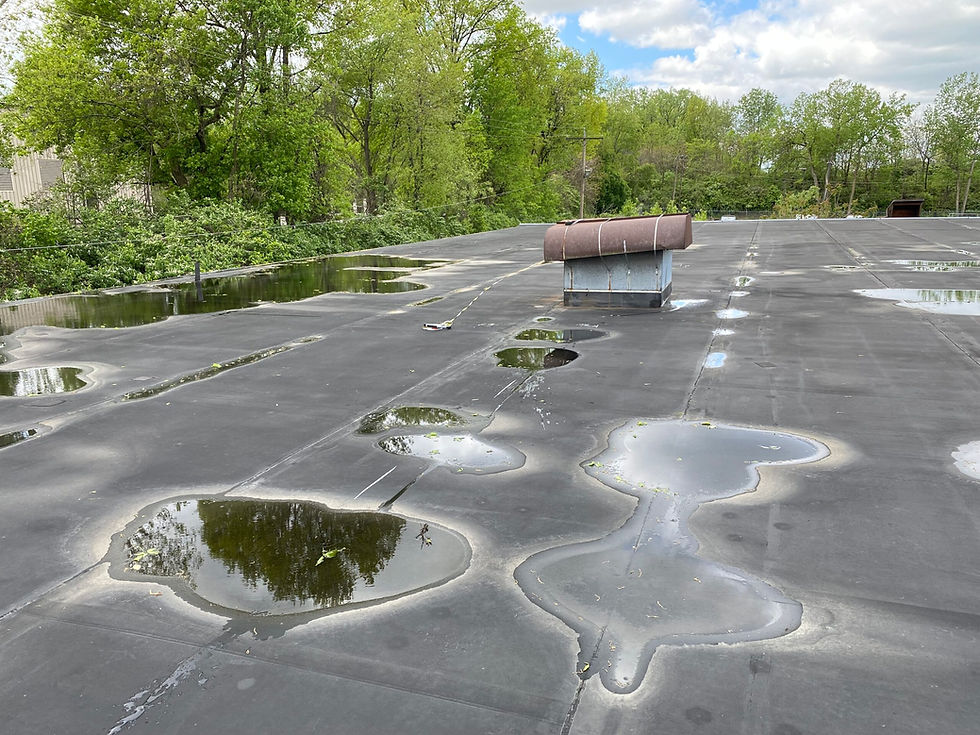
Ponding Water on a Commercial Roof: Why It Matters in Houston
Ponding water is water that remains in low areas of a roof after the rest of the roof has had time to drain. It is common on low-slope roofs, but it should not automatically be treated as harmless.
Houston’s heavy rain can expose drainage problems quickly. A partially blocked drain, a low area created by compressed insulation, or a section of deflected decking may hold water after every storm.
What Can Ponding Water Do to a Commercial Roof?
Persistent ponding can contribute to several problems.
More stress on seams and flashing: Water remains against laps, penetrations, curbs, and repair areas longer than intended.
Faster deterioration in vulnerable materials: Some membranes, mastics, sealants, and coatings are more tolerant of standing water than others.
Wet insulation: If water enters through a seam, puncture, drain, or flashing detail, insulation can absorb and spread moisture beneath the surface.
Deck corrosion or decay: Trapped moisture may contribute to corrosion in steel decking or deterioration in wood and other moisture-sensitive components.
Additional roof weight: Water is heavy. Large or deep areas of ponding deserve prompt evaluation, especially when the roof deck appears to deflect.
Debris and biological growth: Low areas can collect dirt, leaves, and organic material, making drainage worse and hiding membrane damage.
Interior leaks and business disruption: Water may travel within the roof assembly before appearing in a ceiling, wall, office, retail space, or warehouse.
Ponding water does not automatically mean a roof is in immediate structural danger. However, deep, widespread, or worsening areas—especially where the deck appears to sag—deserve prompt professional evaluation. Poor drainage can increase the risk of leaks and structural damage over time.
Ponding water is often a symptom rather than the original problem. The underlying cause may be:
Clogged drains or scuppers
Inadequate slope
Compressed or deteriorated insulation
Deflection in the roof deck
Poor original drainage design
Undersized or damaged scuppers
Abandoned rooftop equipment
HVAC condensation discharge
Previous repairs that changed the water path
Debris accumulating around drain openings
Can a Roof Coating Fix Ponding Water?
A coating can restore a qualified roof surface, seal certain details, and provide additional weather protection. Some silicone coating systems are designed to tolerate ponding-water exposure better than other materials.
However, a roof coating does not create slope or move water toward a drain.
If the roof has a drainage problem, the contractor may need to:
Clean or repair roof drains
Modify or replace damaged scuppers
Add crickets behind HVAC curbs
Install tapered insulation
Rebuild isolated low areas
Replace compressed insulation
Correct deflected or damaged decking
Add or modify drainage components
Properly designed tapered insulation helps direct water toward drains. That is different from simply coating over a low spot and hoping the water will no longer matter.
A silicone coating may be part of the right restoration system, but the roof still needs to be inspected for trapped moisture, structural problems, and drainage defects before coating begins.
What Should a Ponding-Water Inspection Include?
A useful ponding-water inspection should determine:
Where the water collects
How large and deep the affected areas are
Whether drains and scuppers are clear and functioning
Whether insulation or decking has compressed or deflected
Whether the membrane has open seams, punctures, blisters, or failed repairs
Whether moisture is trapped beneath the roof
Whether the condition can be repaired locally or requires drainage redesign
Do not assume every low area requires complete roof replacement. Some problems can be corrected with maintenance or localized repairs. Others reveal a larger issue involving slope, insulation, or the roof deck.
For more information about common low-slope systems and failure points, read our guide to flat roofing repairs and replacement in Houston.
Image placement: Add an original photo of ponding water around a drain or low area on a Houston commercial roof.
Suggested alt text: Ponding water on a commercial flat roof in Houston.
Seeing standing water after Houston storms? Request a commercial roof repair inspection before another coating, patch, or overlay is installed.

Should You Repair, Coat, Recover, or Replace the Roof?
The best option is usually the least extensive scope that reliably solves the problem and matches the owner’s expected time in the building.
Commercial Roof Repair
Commercial roof repair is usually appropriate when the problem is localized and the surrounding roof still has useful service life.
Common commercial roof repairs include:
Open TPO seams
Punctures caused by service traffic
Failed flashing around HVAC curbs
Damaged pipe boots or penetrations
Loose metal fasteners or trim
Isolated wet insulation
Drain and scupper repairs
Limited wind or hail damage
The most important part of a roof repair is diagnosis.
A ceiling stain near an HVAC unit does not necessarily mean the roof membrane is the source. Water can enter through the unit, curb, condensation line, wall, or an adjacent roofing detail.
Applying more sealant without identifying the source may temporarily hide the symptom while the actual problem continues.
Learn more about Martin Roofing & Solar’s commercial roof repair services.

Commercial Roof Coating
A roof coating may be appropriate when the existing roof is stable, sufficiently dry, compatible with the proposed coating, and repairable without removing most of the assembly.
A proper coating project may include:
Cleaning and surface preparation
Adhesion testing
Rust treatment on qualified metal roofs
Membrane and flashing repairs
Reinforcement at seams and penetrations
Primer when required
Application to a specified finished thickness
A commercial roof coating should not be treated as ordinary paint.
A coating may be a good option when:
The roof surface is aging but the assembly remains serviceable
Moisture is limited or absent
Seams and penetrations can be repaired
The existing material is compatible with the coating
The owner wants to reduce disruption
Complete tear-off is not yet necessary
A coating is usually a poor choice when the roof contains widespread wet insulation, unstable materials, major deck deterioration, or serious drainage problems.
Read more about commercial roof coatings for flat roofs in Houston.
Commercial Roof Recover or Overlay
A roof recover installs a new membrane over a qualified existing roof instead of removing the complete assembly.
Depending on the system, the project may include removing isolated wet areas, repairing the existing roof, installing a separator or cover board, and adding a new TPO or other approved membrane.
A recover can reduce tear-off, disposal, noise, and exposure of the building. It is not appropriate simply because the owner wants the lowest initial price.
Before recommending a recover, the contractor should evaluate:
Existing roof layers
Moisture beneath the membrane
Deck and structural condition
Existing attachment
Wind-uplift requirements
Slope and drainage
Material compatibility
Manufacturer requirements
Local permitting requirements
For more information about single-ply roofing systems, read our guide to TPO flat roof replacement and repair in Houston.
Complete Commercial Roof Replacement
Replacement is usually the better long-term option when the roof has widespread moisture, repeated failures, deteriorated insulation, deck damage, too many existing layers, or drainage problems that require reconstruction.
A complete replacement may include:
Tear-off and disposal
Roof deck repair
New insulation
Tapered insulation or crickets
Cover board
TPO, modified bitumen, metal, or another specified roofing system
New flashing and edge metal
Drain, scupper, and gutter work
Manufacturer inspections
Warranty documentation
A detailed proposal should identify the complete roofing assembly. It should not simply say “new TPO roof” or “new metal roof.”
The membrane thickness, insulation, cover board, attachment method, flashing, edge details, drainage, and warranty all matter.
Review Martin Roofing & Solar’s commercial roof replacement services.
Commercial Roofing Across Greater Houston
Commercial roof problems vary across Greater Houston because building types, access, tree coverage, industrial exposure, and coastal conditions change by region.
Martin Roofing & Solar provides commercial roofing in Houston and listed surrounding areas including Cypress, Spring, Humble, Sugar Land, Jersey Village, Atascocita, Missouri City, Galveston, The Woodlands, Katy, Rosenberg, The Heights, Tomball, Conroe, Bellaire, Pearland, and Kingwood. Availability in additional Greater Houston communities should be confirmed by address and project scope.
Commercial Roofing in Cypress, Jersey Village, and Northwest Houston
Cypress, Jersey Village, Copperfield, Willowbrook, Champions, and Tomball contain warehouses, retail centers, churches, schools, medical offices, apartment communities, and flex-industrial buildings.
Large roof fields may improve installation efficiency, but these properties often have multiple HVAC units, active loading areas, and tenant operations. Tree debris and storm damage can also affect drains, gutters, seams, and metal components.
For commercial roofing in Cypress, Jersey Village, or Copperfield, look for a contractor that can inspect TPO, modified bitumen, metal, coating, and multifamily roofing systems—not only shingles.
A recurring leak may be caused by an isolated seam or flashing defect. Widespread ponding, repeated patches, and wet insulation may point toward a larger restoration or replacement project.
Commercial Roofing in Spring, The Woodlands, Conroe, and the North
Spring, The Woodlands, Conroe, Humble, Atascocita, and Kingwood include office campuses, shopping centers, medical buildings, churches, schools, apartments, and large commercial developments.
Mature trees can increase debris around drains and scuppers. Occupied campuses may require phased work, protected entrances, parking coordination, and clear communication with property managers.
If a building has several roof sections installed at different times, each section should be evaluated separately. One section may need repair, another may qualify for coating, and another may be ready for replacement.
A commercial roof inspection in The Woodlands or Spring should also examine drainage areas after tree debris, heavy rainfall, hail, or rooftop service work.
Commercial Roofing in The Heights, Bellaire, River Oaks, and Central Houston
The Heights, Spring Branch, Bellaire, River Oaks, Downtown, Midtown, the Galleria area, and other central Houston districts can present different logistical challenges.
Commercial roofs in these areas may have:
Limited staging space
Difficult crane or lift access
Parapet walls
Dense HVAC equipment
Busy sidewalks and parking areas
Older additions with multiple roofing systems
Tight work-hour restrictions
Limited areas for dumpsters and material storage
A smaller roof in The Heights or central Houston may cost more per square foot than a larger suburban warehouse because access, protection, and detailing require more time.
Older commercial buildings may also contain several generations of repairs, coatings, and roof layers. Test cuts or core samples may be needed before deciding whether the roof can be recovered or must be removed.
Commercial Roofing in Katy, Sugar Land, Missouri City, and Southwest Houston
Katy, Sugar Land, Missouri City, Stafford, Richmond, Rosenberg, Fulshear, and surrounding west and southwest Houston communities include warehouses, offices, schools, churches, retail centers, hotels, and multifamily properties.
A Katy warehouse may have a large open TPO or metal roof, while a Sugar Land medical or retail property may have numerous HVAC curbs, walls, drains, and penetrations.
Fort Bend County properties may contain multiple buildings or a combination of low-slope and steep-slope roofs. Owners and property managers should request a building-by-building or section-by-section scope rather than one vague lump-sum description.
Managers of apartments, condominiums, and townhome communities can also review our guide to Houston apartment and multifamily roofing.
Commercial Roofing in Pearland, Pasadena, Deer Park, Baytown, League City, and the South
Pearland, Friendswood, Clear Lake, League City, Pasadena, Deer Park, Baytown, Channelview, La Porte, Galveston, and nearby southeast Houston communities include retail, aerospace, hospitality, medical, warehouse, and industrial properties.
Buildings near the Houston Ship Channel may have chemical, grease, exhaust, or corrosion exposure that affects material selection and coating adhesion.
Properties closer to Clear Lake, League City, Texas City, and Galveston may require closer attention to:
Wind-driven rain
Edge securement
Exposed fasteners
Metal corrosion
Rooftop equipment supports
Flashing at walls and penetrations
Daily weather protection during construction
A commercial roof inspection in Pasadena, Deer Park, or Baytown should include questions about the building’s operations and rooftop exposure. A generic roofing system may not be appropriate for every industrial environment.

What Should a Commercial Roof Inspection Include?
A useful commercial roof inspection should produce more than a one-line replacement recommendation.
Depending on the building, the contractor should evaluate:
Roofing system and approximate age
Separate roof sections and additions
Seams, fasteners, flashing, and penetrations
Drains, scuppers, gutters, and ponding areas
Previous repairs and coating condition
Interior leak locations
HVAC curbs and rooftop equipment
Signs of wind, hail, or impact damage
Wet insulation or suspected trapped moisture
Deck condition visible from above or below
Access, staging, and occupied-building requirements
For significant restoration, recover, or replacement projects, moisture scanning, core cuts, or test cuts may be appropriate.
After severe weather, Martin Roofing & Solar also provides commercial storm-damage roof inspections. If damage may be part of an insurance claim, the commercial roof insurance claim page explains the inspection and documentation process. Coverage decisions remain with the insurance carrier.
How to Compare Commercial Roofing Proposals
Do not compare only the final price. Compare the complete scope.
Ask whether each proposal includes:
The same measured roof area
The same tear-off depth
Disposal and dumpsters
Insulation type and thickness
Tapered insulation or drainage corrections
Cover board
Membrane thickness or metal specifications
Flashing at every curb, wall, pipe, and drain
Edge metal, gutters, and scuppers
Permit responsibility
Pricing for wet insulation and deck repairs
Manufacturer and workmanship warranties
Daily weather protection
Cleanup and closeout documentation
Two contractors can both quote a “TPO replacement” while pricing very different roofing assemblies.
The better proposal explains what is included, what is excluded, what hidden conditions may change the price, and why the recommended system fits the building.
It should also explain whether other options were considered. When technically appropriate, ask why the roof should be repaired, coated, recovered, or replaced.
Frequently Asked Questions About Commercial Roofing in Houston
How much does a 10,000-square-foot commercial roof cost in Houston?
For preliminary planning, a 10,000-square-foot coating could fall around $25,000 to $75,000, a qualified recover around $50,000 to $100,000, and a complete replacement around $70,000 to $200,000 or more.
The actual price depends on tear-off, insulation, roof deck condition, drainage, penetrations, access, and system specifications.
Is ponding water normal on a commercial flat roof?
Some temporary water may remain after heavy rain, but persistent ponding should be evaluated. It can indicate blocked drainage, low insulation, roof deck deflection, or inadequate slope.
Will a silicone roof coating fix ponding water?
A compatible silicone coating may tolerate ponding-water exposure better than some other materials, but it does not create slope. Drainage, low areas, and trapped moisture still need to be evaluated.
Can TPO be installed over an existing commercial roof?
Sometimes. The existing assembly must be evaluated for moisture, compatibility, attachment, structural condition, existing roof layers, drainage, local requirements, and manufacturer specifications.
When should a commercial roof be repaired instead of replaced?
Repair is usually appropriate when the failure is isolated and the surrounding roof remains serviceable.
Replacement becomes more likely when failures, moisture, insulation deterioration, or deck damage are widespread.
What is the best commercial roofing system for Houston?
There is no single best roofing system for every Houston building.
TPO, modified bitumen, metal, coatings, and other systems can all be appropriate depending on the roof deck, slope, drainage, building use, exposure, budget, and ownership plans.
How often should a commercial roof be inspected in Houston?
A commercial roof should be checked regularly and after major storms, active leaks, drainage changes, or work by HVAC and other rooftop contractors.
The exact inspection schedule should reflect the roofing system, warranty, age, building use, and previous problems.
Can a Houston business remain open during roof replacement?
Often, yes.
The contractor may phase the work, protect entrances, coordinate noisy operations, and keep each open section watertight. Medical, retail, industrial, restaurant, and multifamily properties may require additional planning.
Does Martin Roofing & Solar work outside Houston city limits?
Martin Roofing & Solar serves commercial properties across Greater Houston, including listed areas such as Cypress, Jersey Village, Spring, The Woodlands, Conroe, Katy, Sugar Land, Pearland, and Galveston.
Contact the team to confirm availability for a specific commercial property address and scope.
Schedule a Commercial Roof Inspection in Greater Houston
A commercial roof should not be repaired, coated, recovered, or replaced based on age or square footage alone.
The right recommendation starts with the actual condition of the membrane, metal, flashing, insulation, drainage, and roof deck. It should also account for the way the building is used and how long the owner plans to keep the property.
Martin Roofing & Solar serves commercial properties throughout Greater Houston, including Houston, The Heights, Cypress, Jersey Village, Copperfield, Spring, The Woodlands, Conroe, Humble, Atascocita, Kingwood, Katy, Sugar Land, Missouri City, Richmond, Rosenberg, Pearland, Pasadena, Deer Park, Baytown, Clear Lake, League City, Galveston, and surrounding communities, subject to project availability.
Call the Houston office at 832-617-4037, contact Martin Roofing & Solar, or book a free commercial roof inspection


Comments